A Comprehensive Engineering Guide to Optimizing Material Handling, Product Quality, and Operational ROI.
Pneumatic conveying systems are widely used in industries such as food processing, dairy powder, coffee, flour, plastics, chemicals, minerals, and pharmaceuticals manufacturing to transfer powders and bulk materials efficiently through pipelines using air pressure or vacuum.
Choosing the wrong conveying system can lead to:
– pipe blockage
– excessive product breakage
– dust leakage
– high maintenance cost
– energy waste
– production downtime
This guide explains the key engineering and operational factors to consider when selecting the right pneumatic conveying system for your factory.
1. Understanding Your Material Characteristics
The primary failure point in many systems is a lack of rigorous material analysis. A system designed for a generic “powder” will inevitably encounter operational instability when faced with real-world material variability.
In industries like food processing, dairy, coffee, flour milling, plastics, chemicals, minerals, and pharmaceutical production, the physical properties of your powder or granule dictate every engineering parameter.
These are the few factors to consider:
Bulk Density and Particle Shape
Particle size affects how easily the material can flow and remain suspended during conveying. Fine powders behave very differently from larger granules, especially in how they absorb air, flow through pipes, and react to humidity. Particle shape and surface texture determine the air resistance and the likelihood of material “bridging” within the feeding mechanisms.
The bulk density (expressed in kg/m^3) determines the volume of air required to move the material. Heavier materials require higher pressure or velocity, while irregular particle shapes (like flakes or fibers) can affect how the material “aerates.”
Abrasiveness and Friability
- Abrasiveness: Materials like silica sand, cement, or sugar act as sandpaper on your pipes. Choosing a system with the wrong velocity will lead to pipe wall thinning and eventual failure.
- Friability: Fragile materials (e.g., milk powder, instant coffee, tea leaves, cocoa powder, pharmaceutical granules, and specialty food ingredients) can easily break or “fines” during transport. If product integrity is your primary KPI, your system must be designed for low-velocity transport.
The Humidity & Cohesiveness Factor
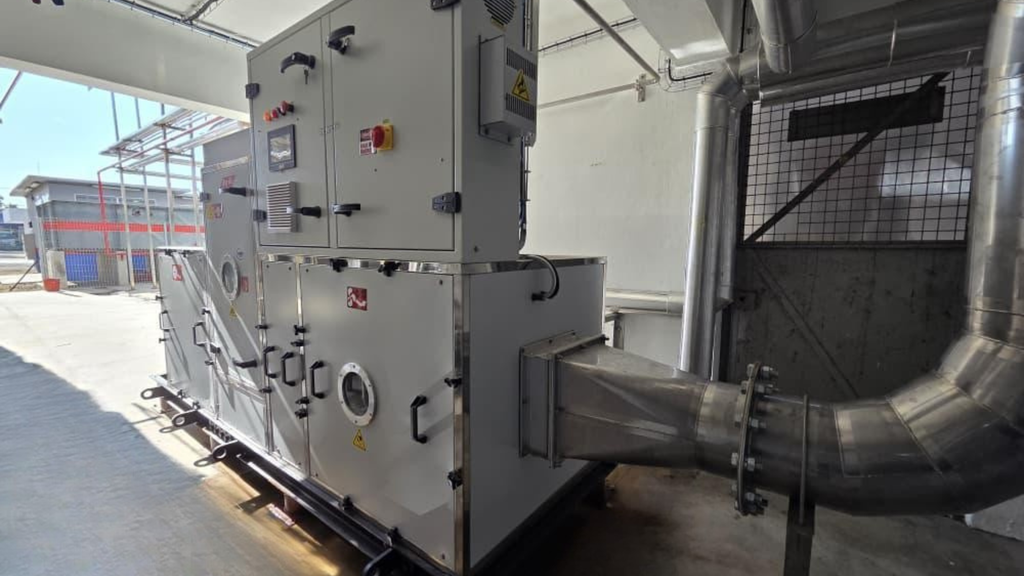
In humid tropical environments like Malaysia, moisture control becomes extremely important for powders such as milk powder, coffee, silica gel, and chemicals that absorb moisture easily. Without proper airdrying and temperature control, powders can become sticky, cause pipe buildup, and eventually block the conveying line.
2. Distance, Routing, and Capacity Requirements
Your plant layout is as important as the material itself.
To determine the “Equivalent Length”
Conveying distance is not measured only by straight pipe lenght between point A and point B as its equivalent length.
Elbow, bend, and vertical lift adds “equivalent length” and resistance (pressure drop) to the system.
- Horizontal vs. Vertical: Moving material 50 meters vertically requires significantly more energy and pressure than 50 meters horizontally.
- Routing Flexibility: pneumatic conveying solutions are capable of routing pipes around existing machinery. However, excessive bends can increase the risk of blockages and material attrition.
Throughput Capacity
Clearly defining your required Tonnes Per Hour (TPH) is vital. An undersized system will become a bottleneck for your entire production line, while an oversized system will waste energy and potentially damage material due to excessive airflow.
3. Phase Dynamics: Dilute Phase vs. Dense Phase
The most critical decision in pneumatic conveying system design is the selection of the conveying phase. This choice dictates the energy consumption, wear and tear rate, and maintenance schedule.
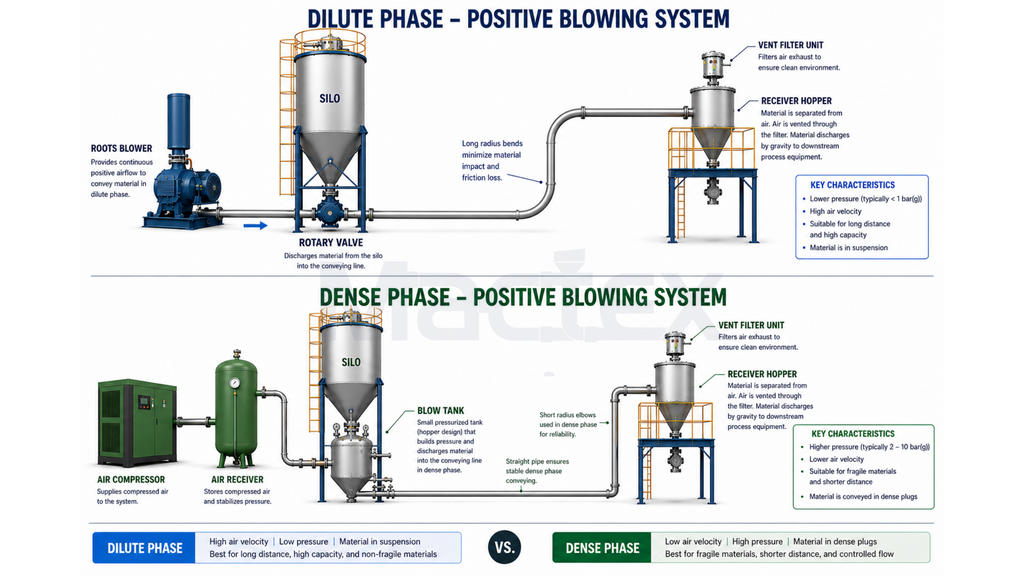
Dilute Phase (High Velocity, Low Pressure)
In a dilute phase system, the material is suspended and carried by high-speed airflow throughout the pipeline.
The system relies on sufficient conveying air speed to prevent material from settling inside the pipe. Because the material is continuously suspended in the airflow, dilute phase systems generally operate at higher conveying velocities compared to dense phase systems.
Application:
Dilute phase conveying is commonly used for non-fragile and non-abrasive materials where lower initial system cost and simpler operation are priorities.
However, the higher conveying speed may increase:
- pipe wear
- dust generation
- particle breakage
especially when handling abrasive or fragile materials.
Dense Phase (Low Velocity, High Pressure)
Dense phase conveying moves material at lower conveying speed in compact slugs or dunes rather than fully suspending the particles in air.
Because the material travels more slowly, dense phase systems help reduce product degradation, dust generation, and pipeline wear. This makes the system more suitable for sensitive or abrasive materials that require gentle handling.
Application:
Dense phase conveying is commonly used for fragile, abrasive, or high-value materials such as:
– milk powder
– coffee powder
– pharmaceutical ingredients
– minerals
– specialty chemicals
Although the initial investment is genarally higher, dense phase systems often provide better long-term reliability and lower maintenance cost for demanding applications.
Which is right for you?
Generally, if your product is expensive, fragile, or abrasive, Dense Phase is the industry-standard choice for long-term ROI.
| Feature | Dilute Phase | Dense Phase |
| Conveying Speed | High | Low |
| Product Damage | Higher | Lower |
| Pipe Wear | Higher | Lower |
| Energy Efficiency | Moderate | Better for long-term |
| Suitable Materials | Non-fragile | Fragile/Abrasive |
| Initial Cost | Lower | Higher |
4. System Configuration: Pressure vs. Vacuum
Pneumatic conveying system generally operate using either vacuum (negative pressure) or blowing (positive pressure). The conveying method (positive pressure or negative vacuum) is determined by the number of intake/discharge points and the sensitivity of the material.
Negative Pressure (Vacuum) Systems
Vacuum systems are typically utilized for upstream intake applications.
They are ideal for:
- Multiple Pickup Points: Pulling material from several silos or bags into one mixer.
- Hazardous Materials: inherent dust containment. Any breach in the system results in outside air entering the system rather than material leaking out. This is a critical safety feature for handling toxic or volatile powders.
Vacuum systems do come with limitations due to the maximum achievable vacuum, which restricts the maximum conveying distance and throughput capacity.
Positive Pressure Systems
Pressure systems are the “blowers”. They are high-capacity transport systems.
They are best for:
- Long Distances convey: They can move material over much greater distances than vacuum systems.
- Multiple Destinations: Capable of much higher pressure differentials, allowing for transport over hundreds of meters and through complex manifolds, pushing material from one central silo to several different packaging lines or mixers.
The pressure system requires high-integrity feeding devices, such as rotary valves or pressure vessels, to prevent gas blow-back into the feeding hopper.
5. Key Engineering Factors that Affect System Performance
When evaluating a how to choose a conveying system proposal, the following technical metrics must be scrutinized:
Pick-up Velocity Optimization
The velocity at the point of material introduction is the most volatile part of the system. If the pick-up velocity is too low, material starts settling inside the pipe, leading to line blockage. If it is too high, energy is wasted, and material is damaged.
In Mactex, we utilize stepped-pipe designs in long-distance systems. By increasing the pipe diameter downstream, we compensate for gas expansion to maintain a constant, optimal velocity and prevent excessive terminal velocities.
Filter Sizing in Filtration
The filter receiver is the lungs of the system. An incorrect filter sizing in the dust collector will cause high back-pressure, reducing the available capacity for conveying.
Power Consumption
Energy efficiency should be evaluated based on how much power is required to move each tonne of material. The power consumption can be optimized through Variable Speed Drives (VSD) on the blowers or compressors and by minimizing the “idle” air flow during batch transitions.
6. Common Mistakes in System Selection
We often see factories struggling with pneumatic conveying systems that were not properly designed for their actual operating conditions.
The most common mistakes include:
1. Ignoring Air Quality and Humidity: Failing to properly dry and filter the conveying air can cause moisture-sensitive powders to become sticky, resulting in buildup, contamination, and line blockage.
2. Operating at Excessive Conveying Velocity: Air speeds that are too high may lead to product breakage, excessive dust generation, accelerated pipe wear, and higher energy consumption.
3. Inadequate Dust Collection and Filtration: An undersized dust collector or filter receiver can reduce conveying stability, causing pressure fluctuation, throughput reduction, and frequent cleaning downtime.
4. Poor Pipe Routing Design: Excessive bends, sharp elbows, and unnecessary vertical lifts increase pressure loss, material attrition, and maintenance requirements.
5. Limited Maintenance Accessibility: Difficult pipe access can significantly increase downtime during blockage troubleshooting, cleaning, and maintenance work.
6. Mixing Components from Different Vendors: Selecting blowers, valves, filters, and pipelines independently may create airflow mismatch and unstable conveying conditions.
7. Inconsistent Product Feeding: Poor airflow balance or unsuitable feeder design may cause unstable material flow, resulting in inconsistent batching and process interruption.
8. Dust Explosion Risk: Improper dust control and insufficient explosion protection may increase safety risks when handling combustible powders in enclosed systems.
9. High Compressed Air Consumption: Oversized blowers, excessive conveying velocity, and air leakage can significantly increase compressed air and energy operating cost.
10. Frequent Maintenance Shutdown: Recurring blockage, excessive pipe wear, and difficult cleaning access may lead to repeated maintenance downtime and reduced production efficiency.
7. Signs Your Pneumatic Conveying System May Need Upgrading
As production demand, material characteristics, and factory layouts evolve, older conveying systems may no longer operate efficiently under current process requirements.
Common warning signs include:
1. Frequent Pipeline Blockage
Recurring blockage may indicate incorrect conveying velocity, poor airflow balance, unsuitable routing design, or material buildup caused by humidity.
2. Excessive Product Breakage or Dust
High conveying velocity can damage fragile materials and generate excessive fines, reducing product quality and increasing housekeeping requirements.
3. Increasing Pipe Wear and Maintenance
Frequent pipe replacement, elbow wear, or unstable system pressure may indicate that the system is operating beyond its optimal conveying condition.
4. Unstable Throughput or Feeding
Inconsistent material transfer can create batching problems, mixer instability, and production bottlenecks throughout the process line.
5. Rising Energy Consumption
Oversized blowers, air leakage, and inefficient conveying conditions may significantly increase compressed air and electrical power usage over time.
6. Difficulty Meeting Hygiene Requirements
Older systems may struggle to meet modern hygienic standards due to poor cleanability, product residue buildup, and long cleaning downtime.
7. Production Expansion Requirements
When increasing production capacity or adding new process lines, the existing conveying system should be reviewed to ensure it can support the new operating conditions efficiently.
8. The Mactex Difference: Custom EPCC vs. Component Sourcing
The “Frankenstein System”—buying a blower, a valve, and a filter from different vendors—is a common cause of operational failure. The lack of a single point of responsibility for the pressure drop calculation and system curve matching leads to perpetual commissioning issues.
While it is tempting to buy individual components (a blower from Vendor A, a rotary valve from Vendor B) to save on initial Capex, this is a high-risk strategy.
Why Custom EPCC is Superior
A pneumatic conveying system is a unified process. The air mover must match the feeder, which must match the pipe diameter, which must match the filter receiver.
Mactex Turnkey Solutions provide:
- Integrated Engineering: Matching the air mover’s performance curve to the system resistance.
- Legal Compliance: Adherence to DOSH/JKKP (Malaysia), ATEX (explosion safety), and Halal (F&B) standards.
- Local Expertise: Field-proven solutions for the unique climatic challenges of Southeast Asian industrial hubs.
9. Strategic Integration: Automation and Industry 4.0
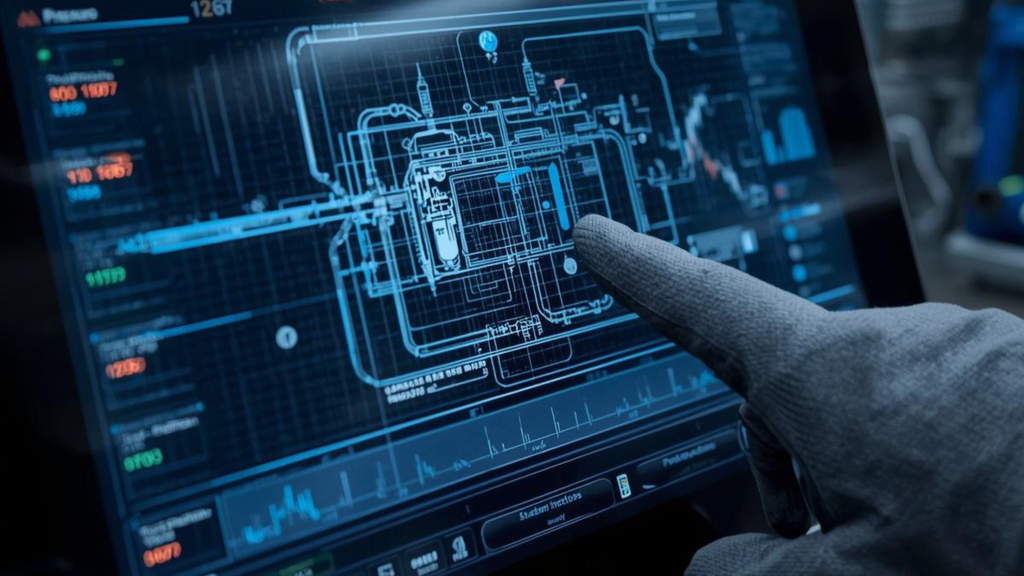
Modern pneumatic conveying systems can now integrate with PLC and SCADA systems to improve monitoring, reduce downtime, and automate blockage detection.
Conclusion: Engineering for Reliability
In the final analysis, a pneumatic conveying system is an investment in process stability. By applying the principles of airflow control, material flow behavior, and correct system selection, engineers can eliminate the variables that lead to downtime.
Whether you are designing for high-capacity mineral transport or ultra-hygienic food powder handling, the technical integrity of the system design is paramount.
Choosing the right pneumatic conveying system is not a purchase—it is an engineering partnership. The goal is to move your material as efficiently as possible while maintaining 100% of its quality.
Are You Ready for a System Audit?
Every material behaves differently.
The right pneumatic conveying system depends on:
– material characteristics
– conveying distance
– factory layout
– hygiene requirements
– throughput targets
Mactex provides customized pneumatic conveying solutions for food, chemical, pharmaceutical, plastics, and industrial applications across Malaysia and Southeast Asia.
Contact Mactex today for a technical consultation or system audit
What to know more? You may refer to our FAQ section here.